Environmental testing for small satellites
On-demand thermal vacuum and vibration testing for components, subsystems and complete small satellites. Get the infrastructure, the engineering expertise and the data analysis without investing in your own facility.
Thermal vacuum
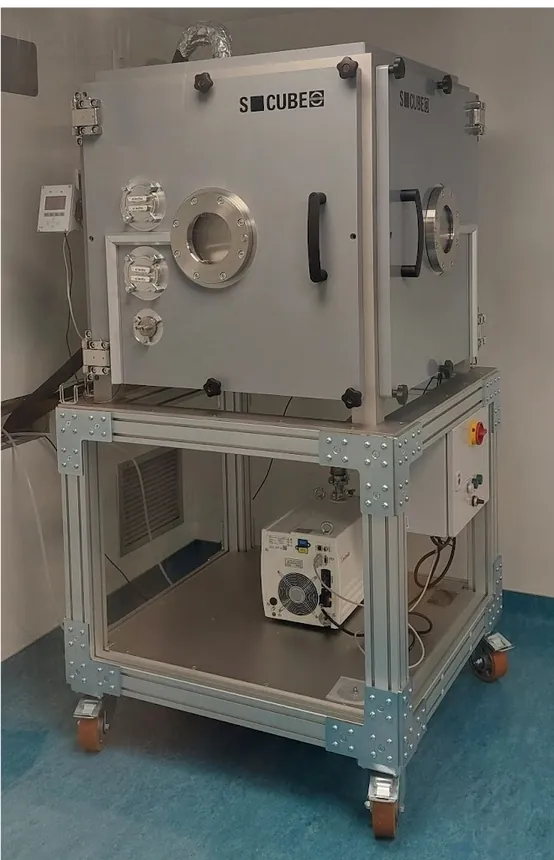
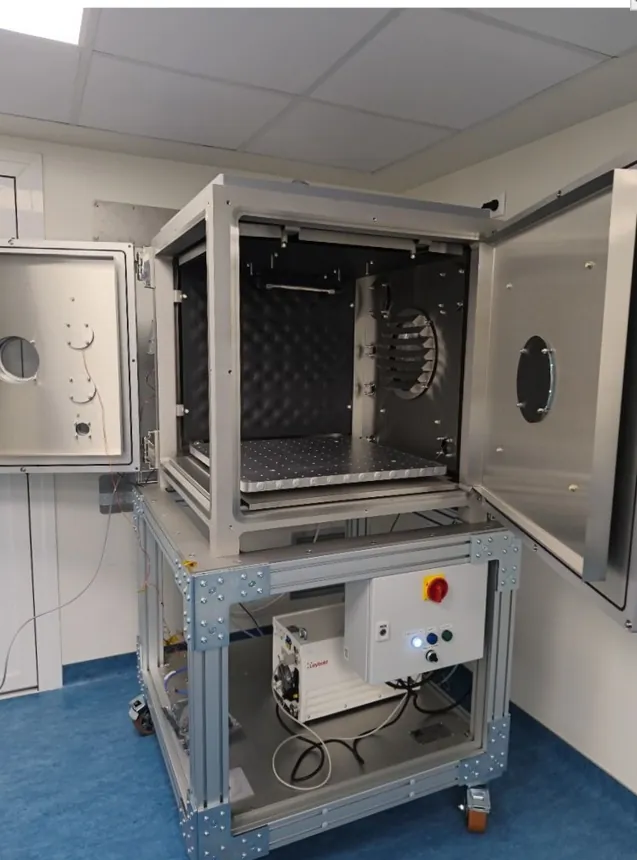
Our S-CUBE 800 chamber exposes components, subsystems or complete small satellites to controlled temperature and vacuum levels, verifying performance, reliability and durability under the conditions of space.
The chamber sits inside the ISO 8 cleanroom, so your hardware moves from integration to test without leaving a controlled environment.
Test types
- Thermal vacuum cycling, operational and non-operational cycles
- Bake-out before integration or launch (nominal 50 °C for 48 h)
- Functional testing at plateaus through electrical and RF feedthroughs
- Component and subsystem screening ahead of flight-model integration
- Available test volume
- 580 × 500 × 580 mm
- Vacuum
- ≤ 1·10⁻⁶ mbar
- Temperature range
- −80 °C … +180 °C
- Feedthroughs
- 48 × electrical, 4 × RF
- Thermal plate load
- 150 kg
- Cooling
- LN₂, 350 L Cryotherm Apollo supply with automatic pressure regulation
- Heating
- Vacuum-compatible heating elements
- Shroud
- Radiation shields on all sides, MAP® PNC black (ε = 0.91 ± 0.03), ECSS-Q-ST-70-09C
- Access
- Two hinged doors, DN160 viewport, ceiling hang points for suspended units
- Interfaces
- Custom flanges machined to spec (ISO-KF, ISO-K, ISO-F, CF)
- Control
- Programmable profiles and ramp rates, remote operation, alarm output
- Location
- Inside the ISO 8 cleanroom
Vibration
A 60 kN electrodynamic shaker with a vertical head expander and a high-pressure slip table, sized for 16U-class CubeSats inside their dispenser test pods.
A 24-channel controller with interface force sensors lets us run force-limited random vibration and notching according to NASA-HDBK-7004C, the approach launch providers ask for.
Test types
- Sine sweep and resonance search
- Random vibration to launch-provider levels
- Sine burst and quasi-static load testing
- Force limiting and notching at the interface
- Qualification, protoflight and acceptance levels, in three axes
- Rated sine force
- 60 kN (6 000 kgf)
- Stroke
- 100 mm (4″)
- Vertical table
- 700 × 700 mm
- Slip table
- 800 × 800 mm
- Control channels
- 24
- Slip-table moments
- High-pressure bearing; pitch 24 kN·m, roll 26 kN·m, yaw 8 kN·m
- Head expander
- Magnesium alloy
- Force limiting
- Triaxial interface force sensors, limiting & notching per NASA-HDBK-7004C
- Sized for
- 16U-class CubeSats in their dispenser test pods, 20 g lateral quasi-static
- Power
- 3-phase 400 V, 50 Hz
How a test campaign runs
A typical thermal vacuum campaign takes 3–5 weeks of bench time and follows a Test Readiness Review / Test Review Board cadence compatible with ECSS programmes.
-
Enquiry
Send us your unit, ICD and test specification, or fill in our option sheet.
-
Test plan
We tailor the profile, instrumentation and fixtures, and write the test procedure.
-
Readiness review
A Test Readiness Review (TRR) confirms setup, procedure and pass/fail criteria.
-
Execution
Testing with functional checks at each plateau. You are welcome to witness.
-
Review & report
A Test Review Board (TRB) and a full technical report with setup, logs and results.
You bring the unit under test, the ICD and the test spec. We bring the bench, the procedures, the instrumentation and the test report.
What we need from you
To prepare an accurate quote, share as much of the following as you have. Our request form covers all of it.
Thermal vacuum
- Device under test and external dimensions (a STEP file helps)
- Vacuum level, maximum/minimum temperatures at the reference point (TRP), operational and non-operational
- Tolerances, number and positions of thermocouples, primary and backup TRP locations
- Number of non-operational and operational cycles, heating and cooling rates, dwell time at plateaus
- Bake-out requirements, placement in the chamber (hanging or standing), pass-through needs
Vibration
- Device under test, mass and CG, dispenser or test pod
- Test levels: sine, random and sine-burst profiles, or the launch-provider user guide
- Test axes, and qualification, protoflight or acceptance levels
- Interface drawing and hole pattern for the fixture or adapter plate
- Number and positions of accelerometers, and any force-limiting or notching requirements
Planning a test campaign?
Tell us about your hardware and test requirements and we will come back with a plan and a quote.